Bardane Pouch | Terre Humaine Capsule Collection
1% donated to the NGO Survival International
The elegant leather pouch for your evenings or travels!
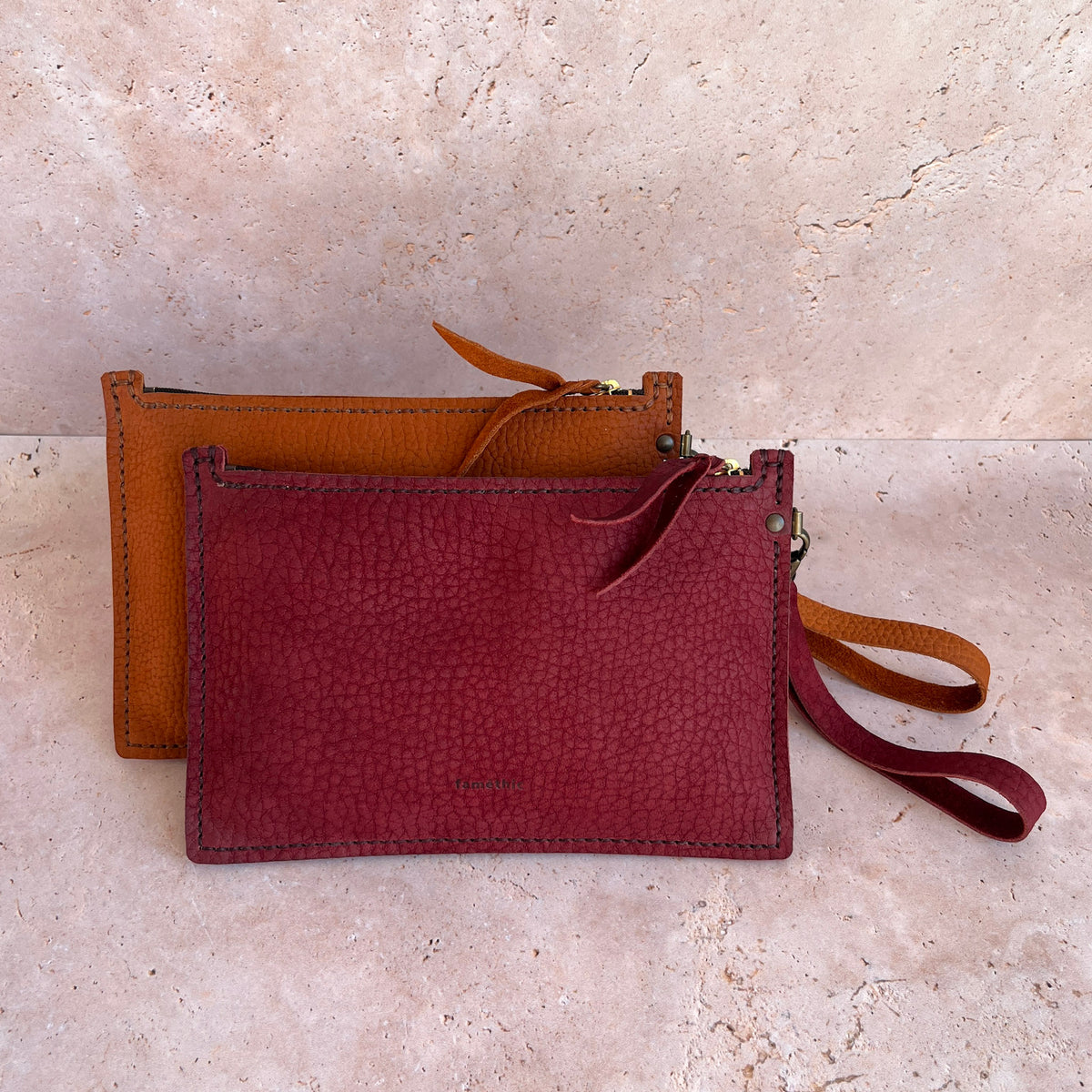
With its removable wrist strap, the Bardane zip pouch will accompany you with refinement on your evenings, special events such as a wedding or baptism, or on your trips.
Organizing your belongings or taking only the essentials, the choice is yours.
Features
- Dimensions: 23.5 cm x 15 cm
- Zip closure
- Removable security wrist strap
Material
The Bardane Terre Humaine is made from full-grain calfskin selected for its aesthetic qualities, strength, and ability to evolve over time.
The pouch is crafted from grained full-grain calfskin with a nubuck finish. Soft to the touch, it has a slightly velvety appearance and naturally develops fine lighter marbling called "repousse," characteristic of high-quality oiled leathers. This leather is made by the Haas tannery in Alsace from hides from its overstock, as part of an approach to valorizing already produced materials. It is a leather that is dyed through and mineral-tanned.
Like any natural material, leather evolves over time. Friction, light, and daily use gradually contribute to the development of a unique patina that tells the story of each bag.
To learn more about the different leathers used in the workshop, the types of tanning, or the natural evolution of the material over time, you can also visit the page dedicated to our leathers.
Learn more about the use of the raw material.
Care
The leathers in the Terre Humaine collection are oiled leathers with a natural finish, designed to develop a patina with use. Already nourished through and through during tanning, they will gradually become lustrous and develop a protective patina under the effects of friction, handling, and care.
The first 4 to 6 months are essential for the formation of this patina. During this period, the new leather is still very absorbent and requires more precautions. Over time, its surface will naturally become more resistant and easier to live with.
During the first 4 to 6 months
We recommend performing care about once a month with the care balm provided with your creation.
Use a very small amount of product. Distribute it carefully on a soft cloth so that it is evenly impregnated: there should be practically no visible material left on the cloth. It should only be very lightly moistened with oil.
Then pass the cloth over the leather by gently and evenly stroking it, without trying to penetrate a large amount of product.
Since the leather is already nourished through and through, it does not need to be abundantly oiled. On the contrary, when it is new, its surface is particularly absorbent: it is therefore important to start with very little product. As the patina develops, the leather will absorb less quickly and care will become easier.
The balm thus accompanies the natural work of tanning. Friction on clothing will gradually polish the surface of the leather; handling and contact with hands also contribute to nourishing it. Little by little, these different elements combine to form a more harmonious and protective patina.
A few precautions at the beginning
During this first period, be particularly attentive to your creation.
Avoid handling it as much as possible with wet, greasy hands, or hands that have just been creamed, as well as any contact with food or other greasy materials. As long as its protective patina is not established, the leather is still very absorbent: stains can penetrate quickly and remain visible for a while, until the leather works and its patina becomes uniform.
Nubuck leather may also show small traces of surface abrasion. They are generally superficial: a simple pass of the finger is usually enough to soften or make them disappear.
And in the rain?
This leather can withstand a few drops, light humidity, or very fine rain. A brief contact with water does not mean that your creation will be stained or damaged.
However, during the first few months, we advise you to avoid deliberately exposing it to the rain as much as possible. The newer the leather, the more quickly it absorbs what comes into contact with its surface. As the patina develops, water will gradually be less likely to penetrate the leather.
If your creation gets slightly wet in the rain, simply let it dry naturally, without intervening further and without placing it near a heat source.
Even once the patina is established, a leather bag is obviously not intended to be soaked: a reasonable rain and prolonged exposure to water are two very different things.
And in the sun?
Like all natural leathers, these leathers also react to the sun and their color will evolve over time.
During the first few months, avoid strong and prolonged exposure so that the patina can form gradually and harmoniously.
Once the leather has developed a patina, it can naturally accompany you much more freely outdoors. However, it is still preferable not to leave a leather creation permanently in the full sun or exposed to very high heat: leather is not meant to "cook" in the sun.
Should the leather be waterproofed?
Waterproofing is not essential.
The patina that is gradually built up constitutes a protection in itself and allows the leather to better withstand humidity over time.
If you still wish to waterproof your creation, you must choose a product without greasy material. The leather is already nourished through and through and also receives its care balm: it is not necessary to multiply the supply of oil.
In case of a stain or dirt
A piece of natural crepe is provided with your creation.
If a material has settled or become embedded in the leather, use the crepe delicately like an eraser, to remove what can be removed.
If the leather, especially when it is still new, has already absorbed a stain—particularly a greasy material—do not try to make it disappear by adding water or a large amount of product. The crepe can help remove the surface, but a stain absorbed into the leather will not necessarily disappear immediately.
After using the crepe, you can perform a light care with the balm, always in a very small quantity and evenly. The goal is not to abruptly hide the stain, but to gradually guide the leather toward a more harmonious patina: the contours of the mark will soften, the color differences will become less pronounced, and the leather itself will evolve and darken slightly over time.
There can therefore be, at the beginning of your creation's life, a period during which certain stains remain visible and the patina still appears irregular. Do not try to multiply the interventions to make them disappear. Simply continue to care for your leather gently and give it time.
As it evolves, these stains will blend into its patina and some will eventually disappear.
Once the patina is established
After about 4 to 6 months, depending on how often you use your creation, the patina will begin to fully fulfill its protective role.
The leather will then be less absorbent and much easier to live with. You will be able to use your creation in more varied circumstances, take it outside or into nature more often, and be less concerned about small everyday stains or light rain.
Care can then be spaced out. We recommend nourishing the leather about twice a year, ideally at the change of seasons:
- in spring, before the strong sun exposure of summer;
- in autumn, before the return of the rains and humidity.
Over the years, it remains important to continue nourishing your leather. A material that dries out deeply gradually loses its suppleness: regular care helps preserve the fibers of the leather and contributes to its longevity.
The golden rule: gentleness and regularity
To care for your creation, always work gently and evenly. It is better to use very little product and renew the care when necessary than to try to quickly transform the appearance of the leather.
The leathers of Terre Humaine were precisely chosen for their ability to evolve. Their tanning gradually expresses its qualities with use: the oil present in the mass of the leather, the care balm, friction, handling, light, and simply time all contribute together to the formation of their patina.
Your creation is therefore not intended to remain as it was the day it left the workshop. Its surface will become lustrous, its color may evolve slightly, some marks will appear and then fade. It is this evolution that will gradually give the leather its character and make your creation a truly unique piece.
Choose options

Human Land Capsule Collection
explore a sensitive way of inhabiting the world
Terre Humaine Capsule Collection